
Customers never notice that you have a new system. They notice that you serve them better.
The research on technology transformation carries good news. In 2024 BCG surveyed more than 1,000 C-suite executives across 59 countries about their large-scale technology programmes and profiled the champions: the 30% that fully met their timeline, budget and scope.1 90% of champions shared the same habits: clear business objectives and scope between business and IT, value cases centred on prioritised business requirements, a shared view of the target architecture, and strong vendor governance. The study also points to joint leadership from the business and technology sides, and to people capability, as major drivers of success. Prosci's benchmarking of more than 10,800 responses across 25 years has returned the same top contributor to success in every edition since 1998: active and visible executive sponsorship. With highly effective sponsors, 79% of programmes met their objectives, nearly three times the rate achieved with the least effective.2
The opportunity is clear. Technology that works is the foundation. This is commodity and most proficient vendors will achieve this for you. The true value comes from the business needs it serves, how you engage your project staff, how you put your business stakeholders in partnership with technologists, and how you engage your supply chain and customers. Connecting these elements forms a virtuous circle. The end goal is equipping your people and systems to serve your customers better. Read on for how we connected this research to practices in three Australian programmes I was part of leading.
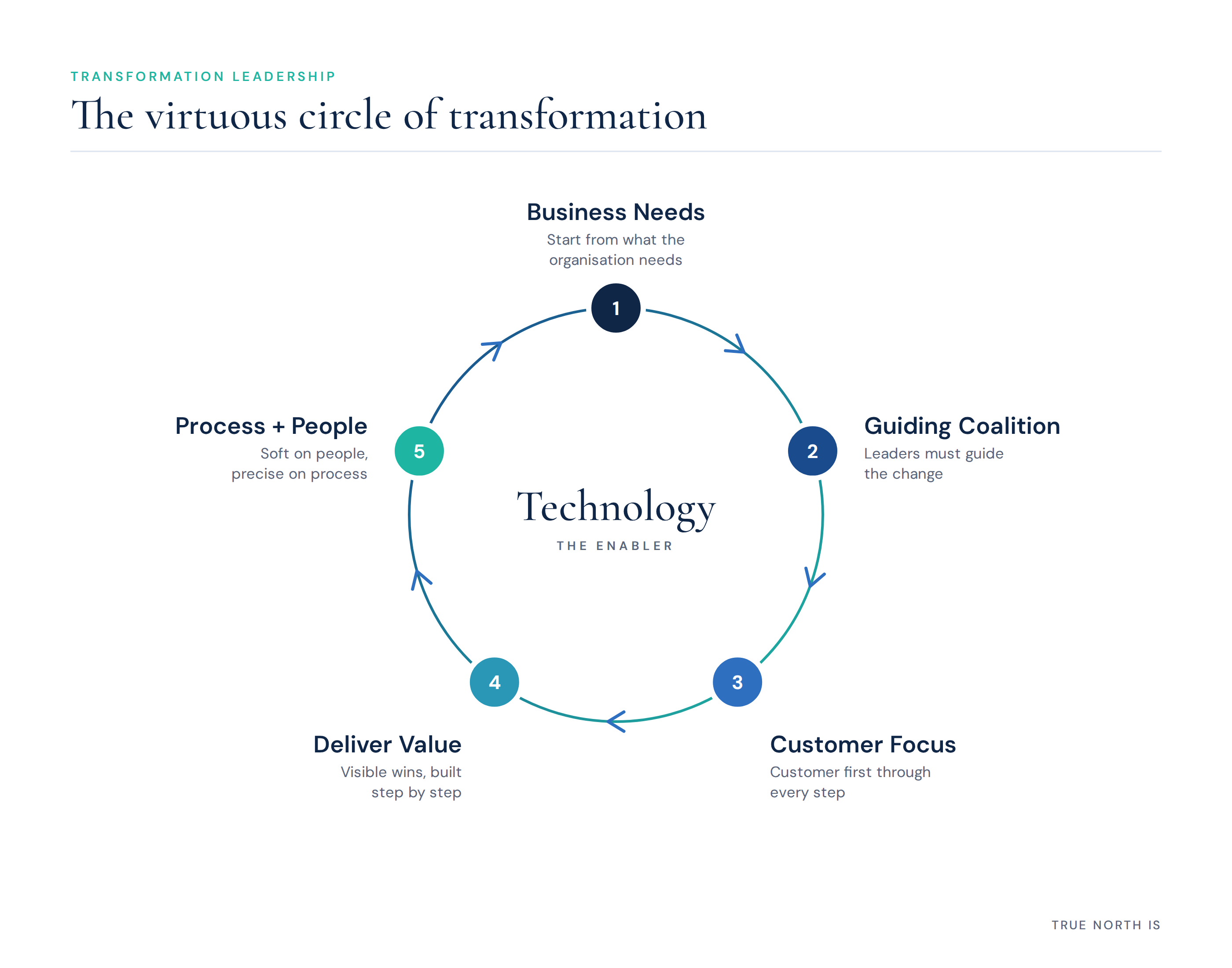
1. Business needs
Defence Housing Australia exists to house Defence families, close to 17,000 of them, in homes spread across the country. The business model combines around 4,000+ Defence owned properties, 12,000+ investor owned properties, a house and land development arm, and a nationwide property services arm. DHA also engages directly with Defence families to help them move and settle in wherever Defence might post them. When its finance, procurement and management information platform came up for renewal, the conversation could easily have been only about systems: which modules, what integration pattern, which cloud. Our Technology Team did have to manage these issues (table stakes). Beyond technology, the programme board co-chaired by the CIO and the head of finance, held better questions on the table. What does a national housing business at this scale need in order to serve Defence families well?
Every design decision, rollout sequence and change activity was tested against the housing mission. For DHA that meant its move to the cloud had to be done professionally, however what really mattered was uplifting our banking reconciliation, our reporting, and transforming the procure to pay systems and processes to empower over 600 staff to more efficiently serve Defence families. That is the first habit of BCG's champions in practice: business objectives and scope, agreed between business and technology, before anything else. When business needs lead, the technology choices clarify. The question moves from "what can this system do?" to "what does the organisation need, and what is the simplest technology that delivers it?" TechnologyOne's cloud ERP made the answer possible, in service of the mission.
2. Guiding coalition
Over a single weekend, Virgin Australia merged Navitaire's New Skies on its domestic network and Amadeus on its international one together onto one Sabre platform. The airline moved from the DJ + VA flight codes to only VA to become a ticketed network carrier, whilst over 80,000 customers were in transit. This required over 4,000 staff in 40+ airports to change in unison. On a single weekend around 50 systems were upgraded in sequence, every hour landing a new go live. Tested. Rehearsed. Managed. The purpose was commercial: winning corporate travellers, global travel agents and alliance partners, and competing head-on with Qantas.
John Kotter's landmark study of transformation puts a powerful guiding coalition among the first steps, and says that in large companies it needs to reach twenty to fifty people.3 McKinsey's 2024 analysis of 44 transformations adds the next layer: returns turn positive once at least 7% of employees own part of the change, and a committed quarter of any group can tip the rest.4
At Virgin we kicked off the Programme by equipping CEO John Borghetti with a detailed pitch pack he delivered to the top 100 company leaders in an invite only, NDA needed session covering the imperative for change. The plan was backed by 9 guiding principles, the first being "this is a business programme, not a technology programme". Virgin's core coalition was around fifty team leaders drawn from every part of the airline: business people paired with Project Managers. Every week they were given a closed room and an open invitation to speak candidly about the programme. Every fortnight myself and three programme leader colleagues led a dozen General Managers in working groups, and monthly the CEO and Executive team met only on this programme. All these sessions were direct, and the team leader sessions could be particularly honest at times. The programme was ambitious, we didn't start with all the answers. The scale and speed of our change was new territory for our US based global vendor, and we had airline, industry and ground partners to engage. I wont pretend those weekly sessions were easy or that myself and my fellow leads got everything correct. The job for those of us in programme leadership was to calmly listen and act, providing solutions and support, giving everyone a voice. Amy Edmondson calls this psychological safety, and her 2023 review of the now-established research links it to how well teams learn, perform and lead through change.5 Virgin's leaders who had been heard in that room walked out and led 500 other project team members with conviction. Many of those team members have gone on to be leaders in the airline today.
Desire comes first. When the leaders genuinely want the change, the five hundred behind them want it too. This programme team in turn led the airline to success.
3. Customer focus
For the cutover the airline put 1,000+ extra front-line staff into terminals and contact centres. It built a disruption app for the transition itself. It stood up a social media team of more than fifteen people so we could listen to and reach customers in real time. Travellers were told plainly what to expect: arrive early, carry a printed itinerary, check in online ahead of the switch. At Suncorp bank my technology transformation invested in new end user capabilies, apps, and support. We performed customer forums to get the app right. We knew that 1M customers would use the new facilities daily to move their money. In both cases customer care was funded and staffed as seriously as the platform itself.
A thousand extra staff so customers felt looked after through the airline's own technology change. That is what "business first" invests — and earns.
4. Deliver value
At Suncorp bank the programme was the New Payments Platform, which gave Australia payments between bank accounts around the clock, with funds available in close to real time. It was built through industry collaboration: twelve founding institutions funded it alongside the Reserve Bank, which built the settlement service.6 Suncorp's Program Board was led by the bank's then Head of Deposits, we worked incredibly closely with colleagues at ANZ, and we drew on more than 100 Suncorp technologists using scaled agile. The team was rebuilding its confidence after a demanding period on core banking, so building confidence became part of the delivery plan.
The first milestone was deliberately small: send a single dollar to a partner bank. We were bridging aging mainframe systems, with API's, with apps, and with NPP clearing that was new to the industry. Teresa Amabile and Steven Kramer analysed nearly 12,000 diary entries from 238 people across seven companies and found that nothing lifts motivation through a working day more than making progress on work that matters.7 Kotter makes the delivery point: "Creating short-term wins is different from hoping for short-term wins."3 Not everything worked every time, some test cycles failed, and sent the team and leaders back to the drawing board. Learnings and wins could be incremental. The $1, sub-10-second transfer was created. So was every capability after it, each a planned and visible win that earned the right to reach for a bigger one. Customer payments moved from days to seconds, and the programme won Suncorp's annual Shine award, chosen from across 7,000+ staff in Insurance and Banking. Eventually our Program Partners (ANZ) spent $5B to buy the bank, and our Program Board Chair (Bruce Rush) became Suncorp Bank's CEO.
5. Process + people
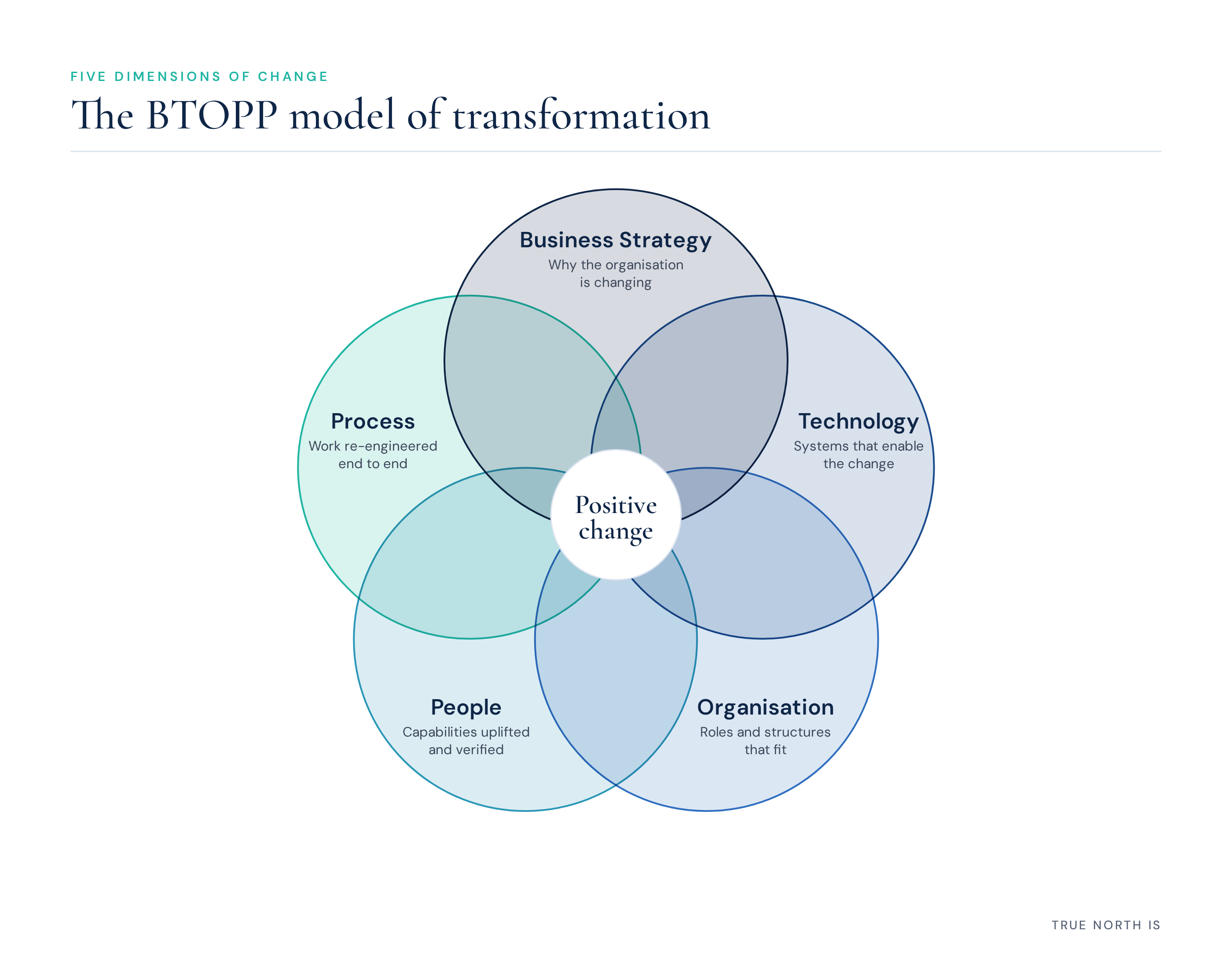
Value is realised when people work in new ways. The BTOPP model keeps that in view by naming five dimensions of change: business strategy, technology, organisation, people and process. Virgin's systems were one part of what changed. My team also embodied our changed business strategy into new policies. We created new organisational roles. We retrained more than 4,000 people, certifying their new capabilities. We re-engineered our passenger processes end to end. With this coordinated approach, guided by our core coalition of executives, general managers, and programme team, the airline changed with us. Suncorp and DHA followed similar patterns. Business strategy, policy, process, organisational roles and people rollout all harmonise with technology to create positive outcomes.
This is leadership work using repeatable patterns. Robert Greenleaf's test of a servant leader was whether the people served grow.8 In delivery this means taking on the hard conversations, with empathy, so the team can move. By remaining precise on processes and supportive in skilling, it allow change to be absorbed by your people. Building confidence into your frontline staff in turn unlocks them to serve the customer in front of them with patience and care.
Then the circle turns again. Better processes and more capable people surface the next business need, and the organisation meets it faster, because the coalition, the customer trust and the confidence are already in place.
The technology is the enabler. The humans are the transformation. The best measure of a technology transformation is simple: your customers can tell.